

As part of our cutting edge R&D work with Dr Leigh Sutherland (www.leighsutherland.com) in Lisbon, we are researching exactly how the fin torsional twist and flex are controlled by the specific orientations of the carbon plies, via computer FSI (Fluid-Structure Interaction) models, in order to fully optimise fin performance.
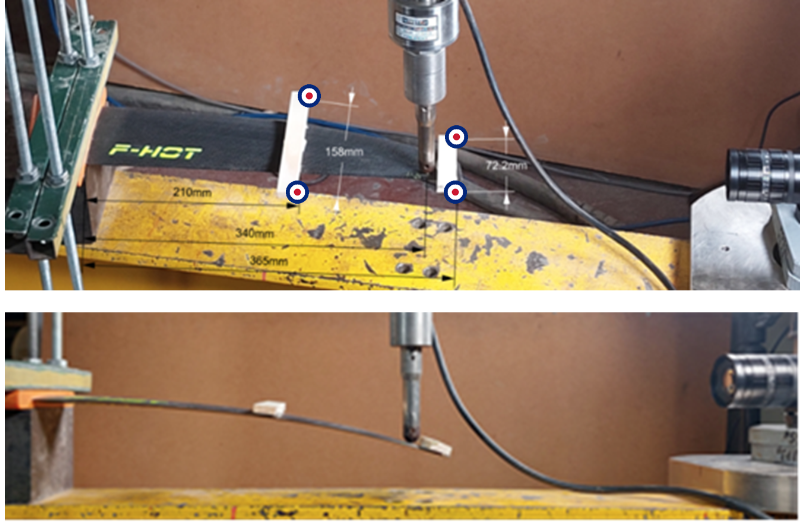
However, computer models need validating with experiments and so we have tested prototype fins on a computer controlled, calibrated servo-hydraulic mechanical test rig using DIC (Digital image correlation) and video-extensometry tracking techniques with Dr Sutherland to check that our computer models correctly predict the twist under loading.
Check how much the (black) fin flexes in the centre of this video as we really load her up!
Video-extensometry tracking
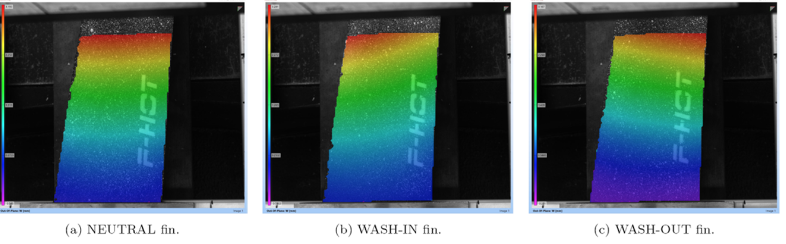
Then, to directly compare different prototypes ‘on-the-water’ (but under scientifically controlled conditions), we tested these prototypes in the State of the Art University of Southampton ‘Boldrewood’ towing tank (https://www.southampton.ac.uk/research/facilities/towing-tank) as part of the Thesis of Thomas Howard MSc supervised by Dr Sutherland (Lisbon) and Dr James Blake (Southampton).
Check how much the (black) fin flexes in the centre of this video as we really load her up!
1710520009685.mp4
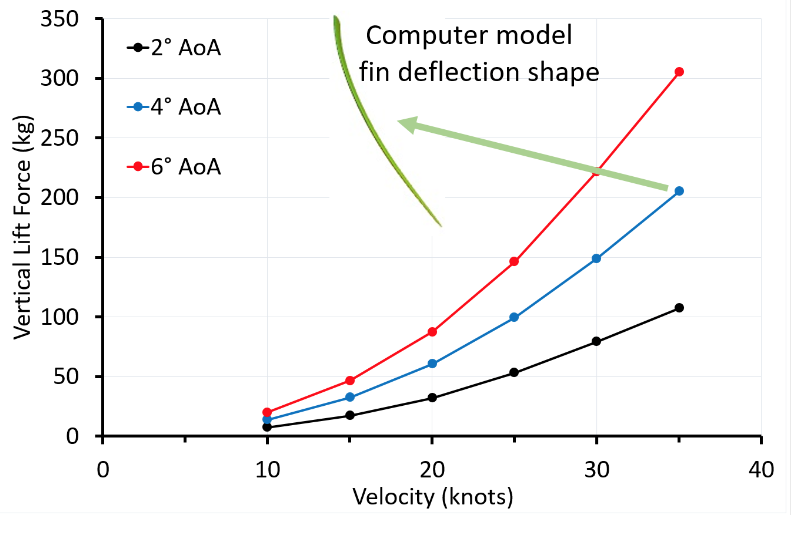
The tank tests verifies our computer predictions showing how F-Hot fins are actually working as fins AND as underwater hydrofoils - both holding you upwind AND lifting the board up, hugely reducing drag. The plot below also shows why you tend to fly if you overload the fin (too high Angle of Attack, AoA) at high speed as it can produce over 200 kg of upward vertical force!
All these mechanical tests and ‘runs’ down the tank give us confidence in the high-tech tools we use to develop our designs and continue to improve the control and performance you know you can expect from F-Hot fins.
Of course, the final ‘proof of the pudding’ is always the feedback from our team sailors, under real-world sailing conditions. And they love them.